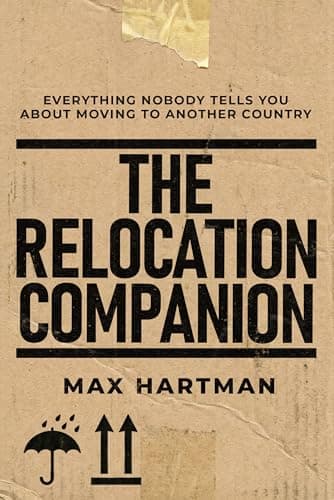
Book
The Relocation Companion
Everything Nobody Tells You About Moving to Another Country
A phase-by-phase guide to moving abroad that handles the visa forms and the kitchen-floor breakdown in the same chapter.
Also available at Bookshop.org · Blackwell's · Foyles · Hive · Wordery · Thalia · Orell Füssli · Adlibris · Saxo · Fishpond
$5.99 on Kindle
182 pages · Published March 31, 2026
“This is the rare expat guide that talks about the visa forms and the 11pm panic. The phase-by-phase structure makes it easy to find yourself in the process and feel a little less alone.”
You've pictured the first morning: coffee in the new kitchen, the place finally starting to feel like yours. Plenty sits between you and that morning, and most of it is the part nobody mentions. That part is what this book is about.
Moving abroad is paperwork — visas, banking, housing, packing, the goodbyes — and it's also everything the paperwork hides: the pre-move dread, the loneliness of month two, the culture-shock spiral, the homesickness that turns up out of nowhere. This book covers both.
What makes it different
- Organised by phase: start at the chapter that matches where you are. Deciding? Chapter 1. Already moved and wondering if you made a mistake? Chapter 15.
- Every chapter answers what you'll do AND what you'll be feeling.
- Both partners, not just the one with the job — eleven chapters address the Driver and Tag-Along dynamic.
- Culture shock mapped to Kalervo Oberg's four stages, with context from Gallup and UN migration data, used where it helps and nowhere else.
- The printable master checklists: pre-departure, first week, first month, cross-referenced to the chapters.
What’s inside
Named systems, and what each does.
The Driver / Tag-Along framework
Language for the asymmetry between the partner with the job and the partner who followed.
The Friendship Funnel
How adult friendship abroad actually works: 20 acquaintances → 5–7 recurring contacts → 2 real friends.
The Dip
The month-three slump, when you start pricing flights home. The book names it, tells you why it shows up, and walks you through it.
The Anchor Activities System
A handful of small routines for the first weeks — a regular café, a class, a standing walk — that give a strange place some structure.
Master checklists
Printable pre-departure, first-week and first-month lists, cross-referenced to every chapter.
Who it’s for
For the 32-year-old moving for work, the 40-something starting over, the 58-year-old retiring abroad, the digital nomad, the company transfer, and the partner who's there because of someone else's job. It tells you what's coming so the first hard week isn't a surprise.
What readers say
“A good, insightful guide to relocating abroad. Even as someone who relocated to Asia from the UK last year, I found several helpful points and questions. For example, the 'Dip' that happens after several months, and how to address it. It's less of a practical planning guide and more of a deep dive into the choices we make and need to make when relocating, and how partner dynamics play out through that process.”
stickleback · via Amazon
“Moving has always been a major headache for me. It's not just the physical exhaustion of the move itself, but also the emotional weight of adapting to a new environment, facing cultural differences, and leaving behind the familiar. That constant cycle often brings deep nostalgia, and at times, it has even led me into depression. That's why I'm so grateful this book exists. For someone like me, who relocates frequently for work, it feels incredibly relevant and necessary. Even though I'm only a little over halfway through, I can already see how useful it is. It's helping me cope, adjust, and navigate these transitions in a healthier way.”
Jordan PC · via Amazon
“We have been planning a move somewhere warmer, and this actually helped me think more clearly about it. I liked how it breaks things down by stages and talks about the emotional side without overdoing it. It felt honest and realistic, not just optimistic. The checklists and simple frameworks were useful. It gave me a better sense of what to expect and how to prepare step by step.”
Nadia · via Amazon
“The Relocation Companion is far more than a checklist for moving overseas—it's a deeply honest guide to the emotional journey that comes with building a new life in a different country. Hartman does an excellent job of balancing practical advice with the realities that many relocation books overlook. From homesickness and culture shock to the challenges of rebuilding friendships and finding a sense of belonging he covers every aspect. What I really liked about this book is its phase-by-phase approach. Instead of overwhelming readers with information all at once, it guides you step by step throughout the relocation process, offering guidance for both the logistical and emotional hurdles ahead. The practical frameworks, checklists, and thoughtful discussion of the "Driver" and "Tag-Along" dynamic for couples I found particularly valuable as that's the difficult part no one talks about.”
Wanderlust1979 · via Amazon
“As someone who spends half her year in another country with her partner, this book hits home. It talks about so much that other books on this broad subject miss: the human perspective beyond the getting there. The author discusses the emotional and psychological aspects of this life-changing relocation and how it can affect each person in the partnership differently. A worthwhile read if you are considering a move abroad or have already done so.”
Adventure_Girl · via Amazon
“It is easy to research visa requirements on our own, it is much harder to predict the emotional toll the move will make on us and the people around us. Many points described in this book match my personal experience from decades ago and it was a good reminder of the things we don't think about when we consider moving. I found it valuable resource for anyone considering making decision of this magnitude.”
Flowergirl · via Amazon
“This is the rare expat guide that talks about the visa forms and the 11pm panic. The phase-by-phase structure makes it easy to find yourself in the process and feel a little less alone.”
Bernard Huang · via Amazon
“As someone who has actually gone through many of the phases described in this book, I found it surprisingly validating. A lot of expat guides stay superficial or focus only on logistics, but this one captures both the practical steps and the emotional reality in a way that feels honest and genuinely useful. Reading it almost felt like a check-in - a reminder that for the most part, I handled my own move as well as I could have. The phase-based structure is smart, and the sections on friendship, culture shock, and the Driver/Tag-Along dynamic are especially strong. It's a great practical blueprint for anyone considering or already navigating an international move, and one I'd actually re-read.”
Mr Paul D · via Amazon
“It's really important to have a guide like this when you're moving or traveling abroad. There are so many things that first-timers can miss, and even experienced travelers can forget important details. Living in a new country is not the same as what you left behind, and that can be harder than you expect. We all hope a new place will bring more happiness, and it can, but only if you prepare the right way. This book walks you through everything step by step from the point of view of someone who has already been there and made mistakes. That means you don't have to learn everything the hard way. It's a very helpful guide for starting your journey the smart way.”
M B · via Amazon
Get the book
Available in several formats. Read it wherever you like.
Also available at Bookshop.org · Blackwell's · Foyles · Hive · Wordery · Thalia · Orell Füssli · Adlibris · Saxo · Fishpond
$5.99 on Kindle
Read it, or thinking about it? Tell me what you think →
Also by Max Hartman

Screen-Proof Family
The Digital Parenting Guide — From First Phone to AI Safety, Age by Age
A guide to raising kids through phones, social media and AI. The wager of the book: your relationship with your kid does more to protect them than any screen-time limit.
$5.99 on Kindle